Learning
ARC
A language learning experience that measures real-world capability instead of daily streaks.
Key idea Capability over consistency.
This is the short version. The full study is here when you have more to give.
The idea
Most language apps reward showing up. ARC rewards what you can now do.
Learners unlock small “worlds,” each one ending in a real skill, not a score.
The framework is Discover → Preview → Prove → Expand. It turns ability into felt progress, and it was built for language learning, not limited to it. It is designed to generalize beyond language: any skill where progress is hard to feel day-to-day.
How I approached it
01 The challenge
How do you make progress feel real without just replacing one gamified pressure with another?
02 The insight
Streak systems measure attendance. They don’t measure whether you can actually use what you learned. “I feel like I’m maintaining an app, not developing a skill.”
03 The bet
If progress is framed as capability, learners feel it more and stick with it longer.
04 The tension
Capability-first but never gamification-free. The tension that shaped every decision below.
The system
One loop, four moments
01 Discover
A new place opens.
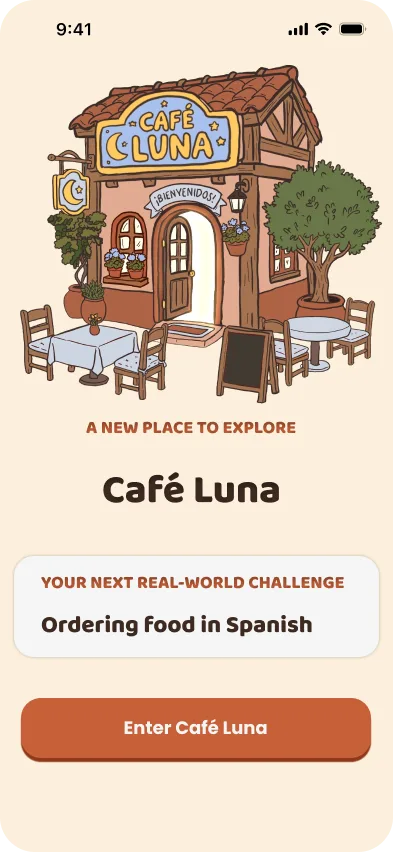
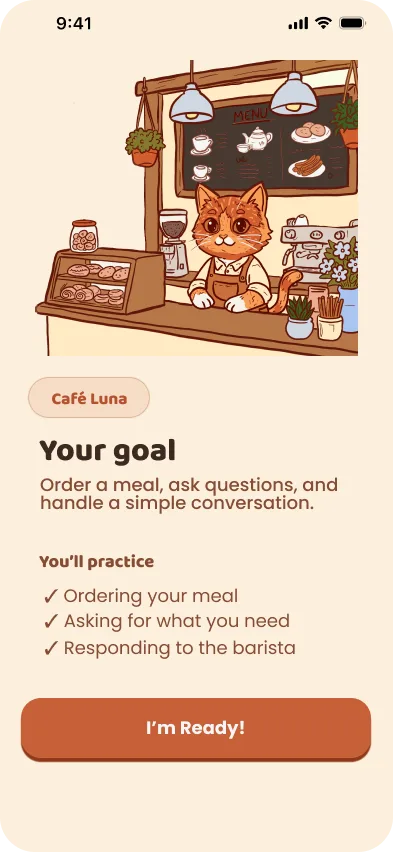
02 Preview
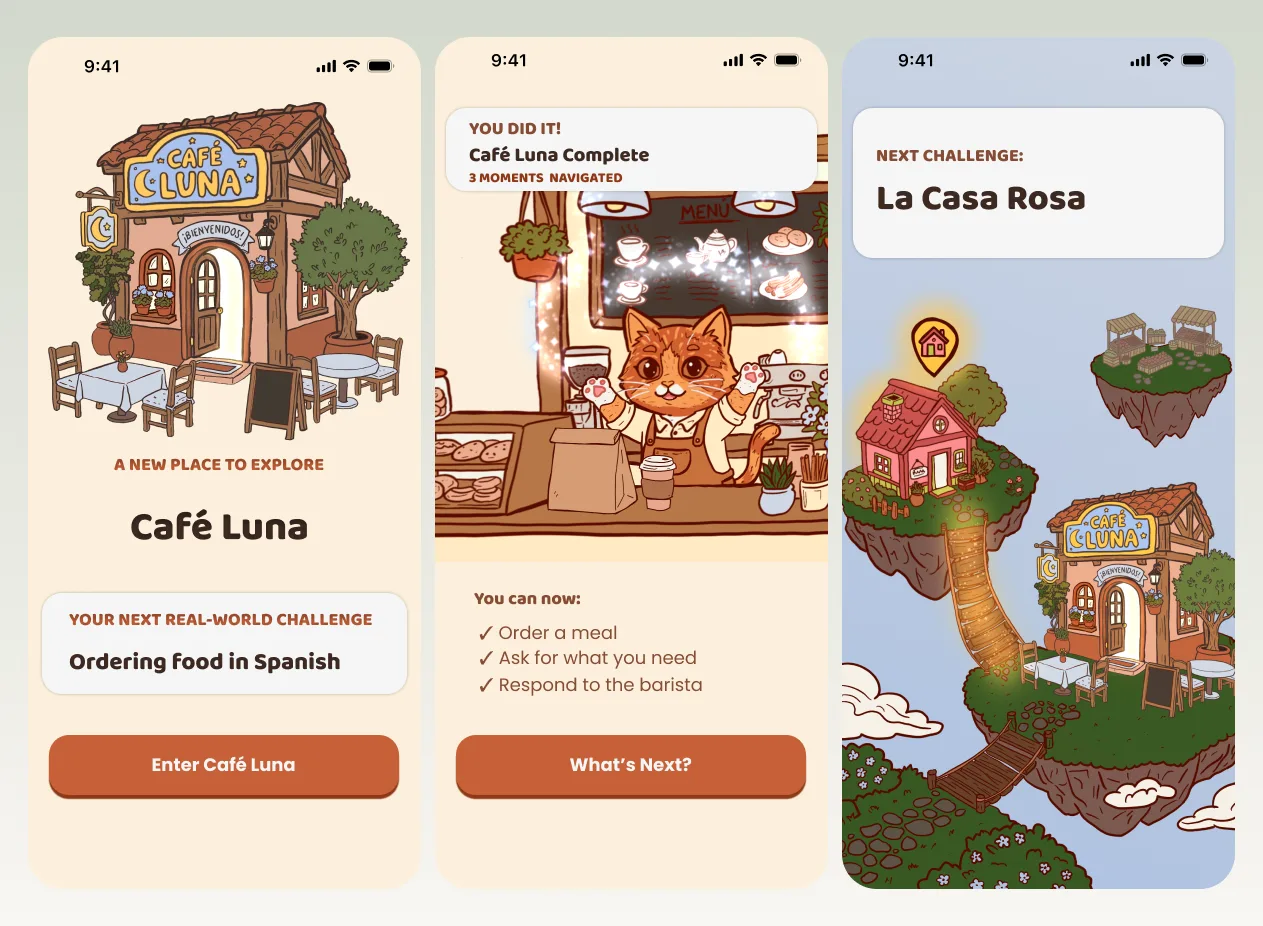
You’ll practice: ordering, asking, responding.
03 Prove
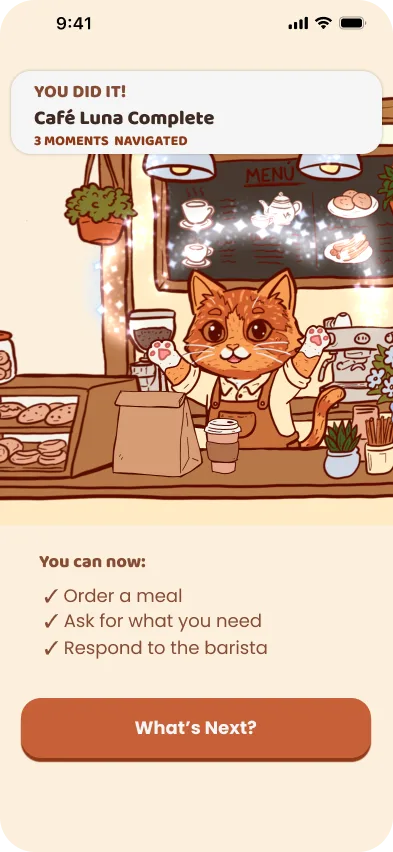
3 moments navigated.
04 Expand
The bridge extends.
Decisions
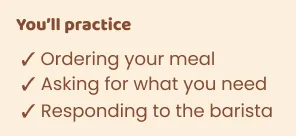
Five screens, seven decisions
01 Discovery framing, not completion framing
“A new place is opening…” Progress framed as entering a place, not finishing a unit.
02 Progressive complexity without gating
The “You’ll practice” checklist states real-world capabilities before simulation starts. Nothing is locked behind a paywall or level requirement.
03 Simulation as default review
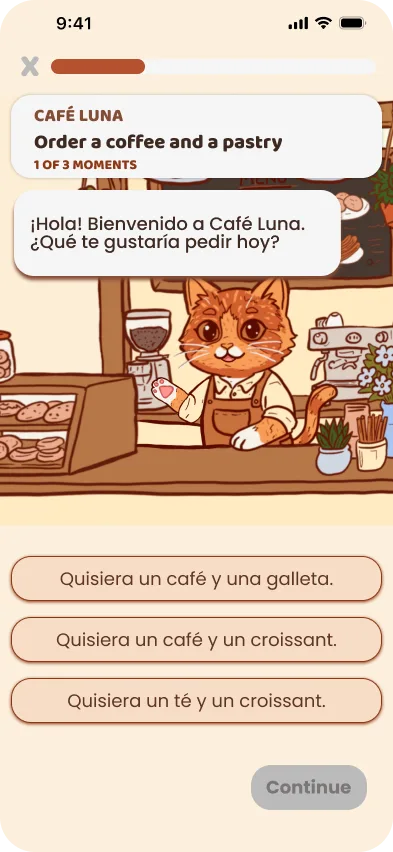
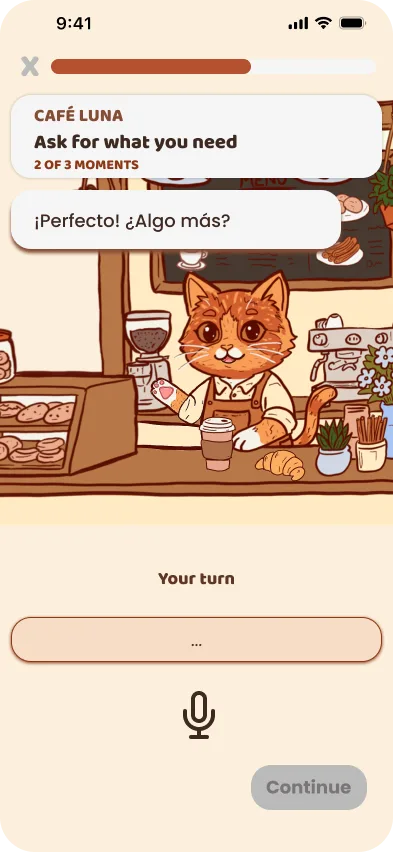
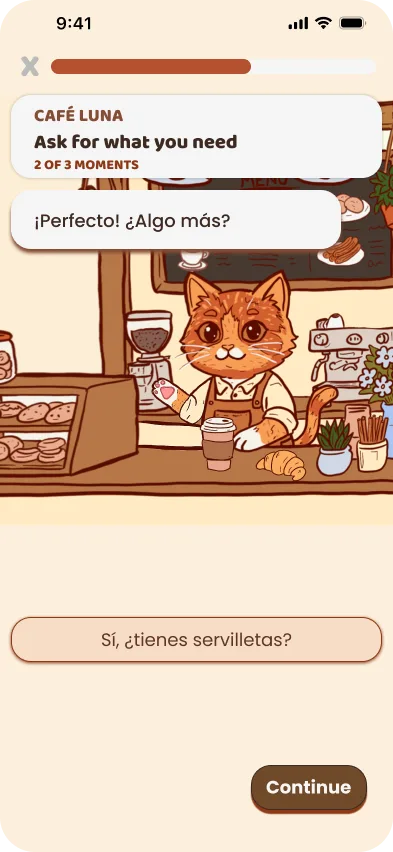
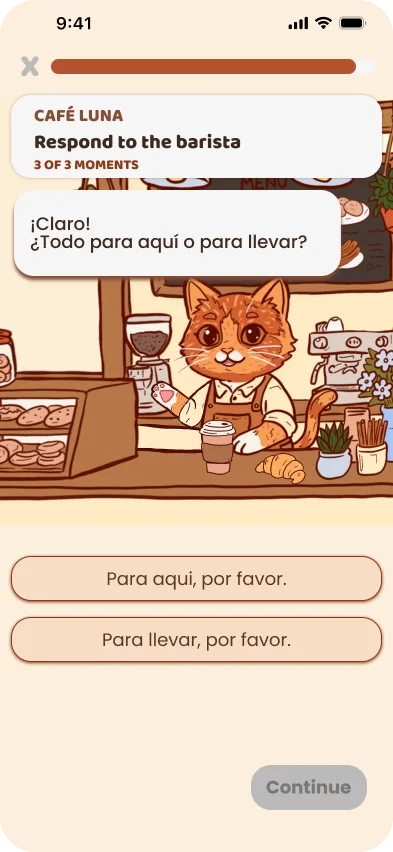
“1 of 3 moments” replaces drilling as the core review mechanic, not a bonus mode after vocabulary practice.
04 Deliberate session pacing
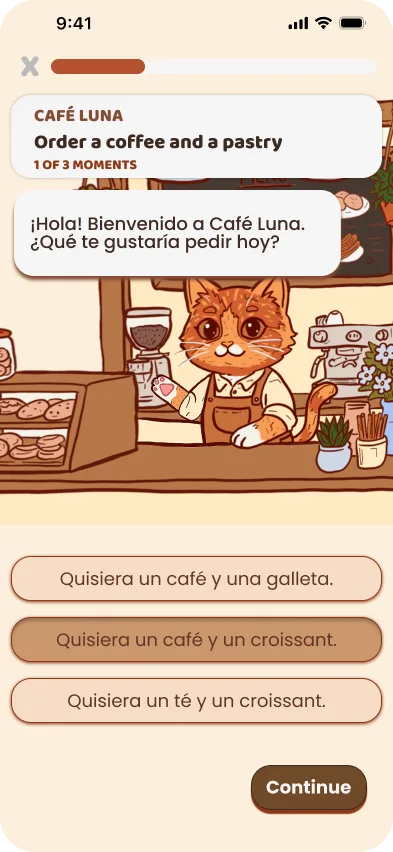
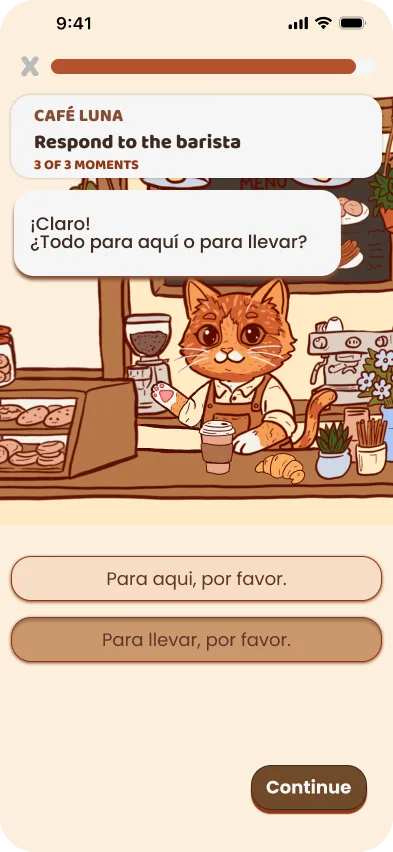
The continue button stays disabled until a choice is made. Three dense moments, not an unlimited quiz queue.
05 Button hierarchy
Outline for choice, solid for confirm, full-width for commit. A visual hierarchy that makes the next tap obvious without instructions.
06 Capability-based feedback
“You can now..” leads the screen. Accuracy score is secondary evidence, not the headline.
07 Spatial, cumulative progression
The bridge extends toward the next location. Progression is spatial and cumulative. You’re building a world, not maintaining a streak.
The prototype
Café Luna, start to finish.







What testing showed
Tested with 6 learners at different levels of engagement, including one on a 413-day Duolingo streak. The finding: meaningful progress is not automatically motivating progress. This became the most important insight in the project and the one that shaped everything after it.
What landed
- “Moments Navigated” read as real conversations, not lesson labels.
- “Restaurant Ready” read as genuine preparedness, not a badge.
- The simulation felt different from a conventional lesson.
What didn’t
- No celebration. No anticipation. No dopamine.
- Participants understood the value, but didn’t feel rewarded.
- The most engaged participant, the one with the longest streak, noticed this fastest.
I can communicate with our dishwashers at work who barely speak any English. Last year I couldn’t say much outside of ‘hola, cómo estás.’ Now we have little conversations.
Reflection
Keep the game loop. Change what it rewards.
Streak systems protect what you’ve maintained, count days shown up, and follow a linear lesson path. ARC unlocks what you can explore next, counts skills gained, and follows a spatial, cumulative world map.
The world map adds anticipation and curiosity. The capability reveal makes progress concrete. Neither one alone was enough. Together, they close the gap the testing surfaced.
She didn’t reach for her streak to describe her growth. She reached for a real conversation. Discover → Preview → Prove → Expand held up across three learner tests, including someone 413 days into a Duolingo streak.
Still open. Whether it changes self-perception, or just changes what gets measured, is the open question for the next round.